Layoffs, Slow Hiring & Role Saturation: What Mid-Career IT Professionals Must Understand in 2026
Naveen Kumar Singh
Naveen is a professional agile coach and has been working independently for a long time in the Asia... Read more
If you talk to mid-career professionals in India’s IT industry today, one word comes up again and again: uncertainty. Some people see layoffs in the news and assume the industry is collapsing. Others hear about AI and assume massive job loss is inevitable. But neither narrative captures the real story.
What we are seeing today in India’s IT sector is not a collapse. It is a restructuring phase. Understanding the differences among layoffs, slow hiring, and role saturation is critical for professionals in the 35–50 age group. Because each of these signals requires a different response.
The Three Signals That Make Everyone Confused
Many professionals treat layoffs, slow hiring, and role saturation as the same trend, but they represent very different shifts in the market. Let’s unpack them.
1. Layoffs: A Reset, Not Always a Collapse
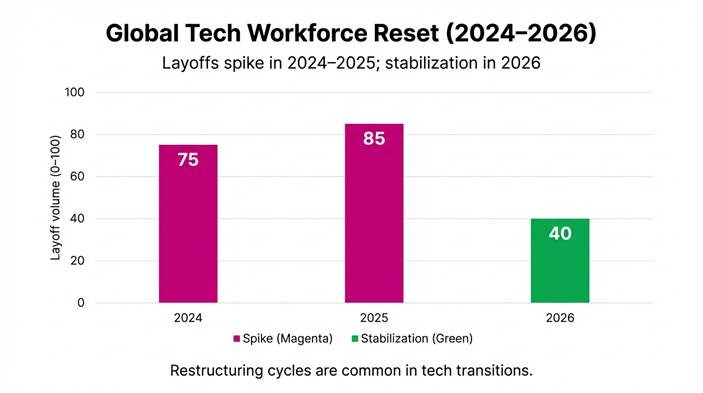
The global tech sector has experienced major restructuring over the past two years. More than 112,000 tech employees were laid off globally in 2025 across 200+ companies, reflecting a broader shift toward automation and cost efficiency.
India has not been immune.
Several global capability centres and multinational firms reduced workforce sizes, with over 5,500–6,000 job cuts reported in GCC operations in India during 2025 due to global cost pressures and restructuring. Even recently, performance-linked reductions have continued in some companies.
But here’s the nuance many miss: most layoffs are not about technology becoming irrelevant. They are about business models changing. Companies are consolidating teams, increasing productivity using AI, reducing redundant roles, and focusing on high-impact capabilities.
Layoffs are painful. But historically, every major restructuring cycle in tech companies has also reallocated talent into new domains.
2. Slow Hiring: A Productivity Shift
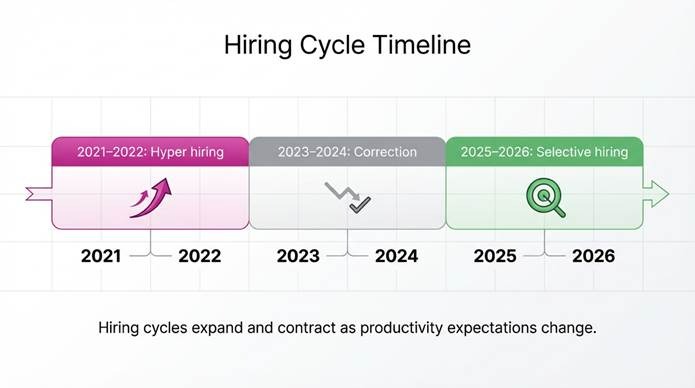
The second signal confusing professionals is the hiring slowdown. At the start of 2026, demand for tech talent in India fell by around 24% year-on-year, reflecting a cautious hiring sentiment across the industry. This slowdown is real. But it is also contextual.
The years 2021–2022 were extraordinary hiring periods, with companies expanding aggressively. Now companies are prioritizing productivity, margin protection, and AI-enabled efficiency. Even the largest Indian IT firms have slowed hiring significantly, with net additions across the top five companies dropping dramatically compared to previous years. Yet the industry continues to grow overall. India’s technology workforce still expanded to about 5.8 million employees, with net additions in recent years despite the slowdown. That’s why this phase is better understood as hiring normalization rather than collapse.
3. Role Saturation: The Most Important Signal
This is the signal most mid-career professionals underestimate. Role saturation happens when too many professionals compete for the same type of role. And this is where AI begins to change the structure of work.
For example:
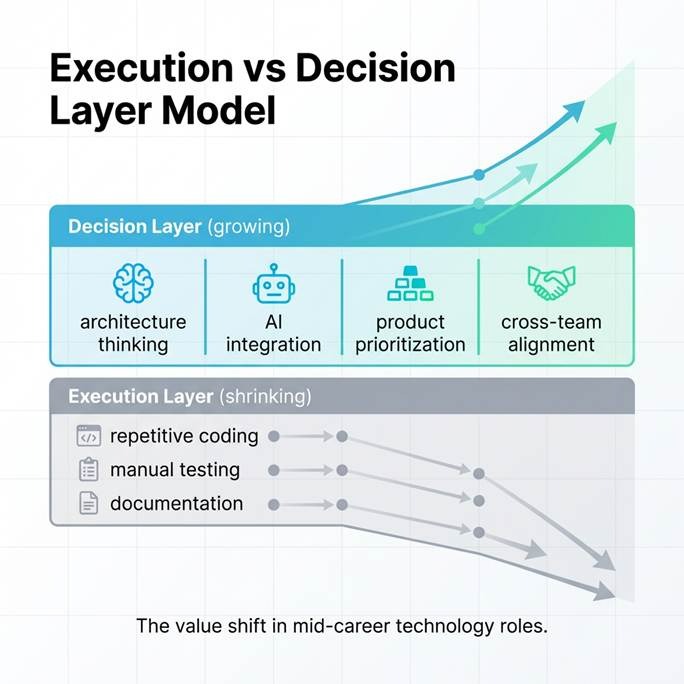
AI tools can now assist with code generation, documentation, requirement summaries, and test case drafting. These capabilities compress the time required for execution. Which means companies need fewer execution-only roles. But here is the critical insight. The demand for decision-oriented roles is actually rising. Companies still need professionals who can:
Define problems clearly
Design systems
Evaluate trade-offs
Align business outcomes with technology
In other words, AI is compressing execution layers but expanding strategic layers.
The Mid-Career Dilemma
This is why professionals in the 35–50 age group feel the most pressure. Early-career professionals are learning. Senior leaders are setting strategies. But mid-career professionals often sit in the execution-plus-coordination layer, which is exactly where automation and productivity improvements are hitting first. That doesn’t mean mid-career professionals are becoming obsolete. It means the definition of mid-career value is changing.
Experience alone is no longer sufficient. Experience must be combined with relevance.
A New Career Formula
In the past, career growth looked like this:
Experience → Seniority → Stability
Today, the equation looks different:
Experience × Relevance = Market Power
Relevance now includes:
AI fluency
System thinking
Product understanding
Business impact awareness
Professionals who combine these capabilities with experience become multipliers inside organizations.
The Role of Scrum Masters Is Evolving 👉🏻 Upgrade Your Skills for 2026
Mid-career Scrum Masters are facing slow hiring, role saturation, and increasing pressure as AI reshapes Agile teams. Those who don’t adapt risk falling behind. **AI for Professional Scrum Master™ – AI Essentials Training** helps you learn how AI fits into Scrum, improves productivity, and prepares you for the new expectations from Agile professionals in 2026.
In my recent conversations with technology professionals and managers, a clear pattern is emerging. Companies are increasingly valuing professionals who can:
Bridge AI tools with real business problems
Connect engineering teams with product decisions
Guide architecture discussions
Reduce ambiguity in complex projects
These are not new skills. But they are becoming far more valuable. Because AI speeds up execution, organizations need more people to decide what to execute.
What This Means for Key IT Roles
Developers: Move beyond writing code to system design and AI integration thinking.
QA Professionals: Automation and AI testing frameworks will dominate quality engineering.
Business Analysts: Clear thinking and problem framing become even more important in AI transformation programs.
Project Managers: Coordination alone is shrinking. Strategic prioritization is rising.
Scrum Masters: Facilitation must evolve toward productivity and workflow optimization.
Product Owners: Backlog management is basic. Outcome measurement is the real differentiator.
The Emotional Side of This Shift
Let’s acknowledge something that statistics don’t capture. For many professionals, mid-career disruption is not just about skills. It is about identity. If you spent 15–20 years building expertise in a particular role, hearing that the role is evolving can feel threatening.
But the truth is, technology careers have always evolved. What is different today is the speed of change. And that means the most valuable skill is not coding, testing, or managing. It is an adaptation.
A Simple 10-Day Career Reset
If the industry is restructuring, the goal isn’t panic. The goal is repositioning. Here’s a simple reset you can start this week.
Day 1–2: Audit your role. What percentage of your work is execution vs decision making?
Day 3–4: Learn one AI workflow relevant to your role.
Day 5–6: Analyze five job descriptions in your domain.
Day 7–8: Update your professional narrative.
Day 9–10: Start one conversation inside your company about AI adoption.
Small shifts in positioning can dramatically change a career trajectory.
Final Thought
Layoffs create headlines. Slow hiring creates anxiety. But role evolution creates opportunity. The professionals who thrive in the next decade will not necessarily be the most technical. They will be the ones who combine experience, adaptability, and strategic thinking.
One more practical step many mid-career professionals overlook is optimizing their LinkedIn profile. In a competitive market, clearly elaborating experience and aligning the profile with the right keywords helps recruiters find the right candidate faster.
The real question for mid-career professionals today is not:
“Is the industry shrinking?”
The better question is:
“How do I evolve faster than the role that’s disappearing?”
Because that answer determines the next phase of your career.
AI Can Now Plan, Code, and Test, Don’t Get Left Behind—Enroll Today!
Software development is moving beyond AI-assisted coding to agent-driven workflows where AI can plan, write, test, and refactor code. Professionals who don’t learn how to guide these systems may struggle to stay relevant as development teams adopt faster, AI-powered processes. Join the Agentic Software Development with Claude Code workshop to learn how to work with autonomous coding agents in real-world projects. Seats are limited, enroll now to secure your spot.
The 6 tech skills that will be most in demand in 2026 (with tests)
Cloud computing, like AWS and Azure
MCP servers.
Cybersecurity, especially AI and the cloud
SQL.
Python.
Agentic AI.
AI can't take over jobs that require a lot of human skills, like empathy, complex physical dexterity, critical judgment, and unique creativity. These jobs include healthcare (nurses, therapists), education (teachers, coaches), arts and high-touch services (artists, elder care, personal trainers, chefs), and specialized skilled trades (plumbers, electricians, complex maintenance) where being able to adapt to real-world situations is important.
There isn't one best IT field, but jobs in AI, cloud computing, cybersecurity, data analytics, and Agile project management are likely to grow a lot in the next few years. In the changing IT industry, professionals who have technical skills as well as problem-solving, business, and AI knowledge will be more likely to keep their jobs.
There is no IT job that is completely safe from AI, but jobs that require making decisions, designing systems, and understanding business are less likely to be replaced. Jobs like solution architect, product manager, cybersecurity specialist, AI engineer, and Agile project leader are safer because they need people to think strategically, make decisions, and solve problems, not just do what they're told.
Sign up for Agilemania Newsletter
Stay updated with the latest Agile & Scrum trends.
Naveen Kumar Singh
Naveen is a professional agile coach and has been working independently for a long time in the Asia Pacific. He works with the software development team and product team to develop awesome products based on empirical processes.












![65+ Software Testing Interview Questions and Answers [Updated]](https://cms.agilemania.com/storage/blog/6a5870bf295f71784180927.jpg "65+ Software Testing Interview Questions and Answers [Updated]")