

Naveen Kumar Singh
Naveen is a professional agile coach and has been working independently for a long time in the Asia... Read more

Naveen Kumar Singh
Naveen is a professional agile coach and has been working independently for a long time in the Asia... Read more

Hiring managers don't look at resumes the same way anymore. As AI tools become more common in the workplace, the focus has changed from just experience to the skills you bring.
Many candidates are now unsure whether to focus on their technical AI skills or their human skills, like communication and problem-solving.
It's not as easy as picking one over the other. Today, they both play different roles in getting work done.
Knowing what employers want can help you show off your skills better and make your resume stand out in a crowded job market.
This blog will help you figure out which skills to focus on, how to balance the strengths of AI and people, and how to show them off on your resume.
Companies hire people in a different way. In the past, just having a job title and a few years of experience was enough to get noticed. Now, employers want to see what you can really do. This change is happening because work is changing quickly, and companies need people who can change with it.
One big reason for this change is that people are using AI more and more in their daily lives. Tools now help with many everyday tasks, like writing emails and looking at data. This means that companies want candidates to be able to use these tools and also be able to think for themselves and make decisions.
Because of these changes, resumes are becoming more focused on skills. Employers want clear proof of skills instead of just a list of roles and responsibilities. They want to know how your technical and people skills help you get things done and solve problems.
AI skills are the things you need to know to use AI tools to get things done faster and better. You don't have to be a programmer to know how to use AI. In most jobs, it just means knowing how to use AI tools to help you do your job better and get better results.
Some common AI skills are:
Using AI tools: Writing, researching, or managing tasks can all be made easier with tools like ChatGPT or other automation platforms. It's a useful skill to know how to use them correctly.
Basic data analysis: Knowing how to read and understand simple data, spot trends, and use tools to make sense of information can help you make better choices.
Prompt writing: This means giving clear and specific instructions to AI tools to get useful and accurate outputs. The better your input, the better the result.
Many jobs now utilize these skills. For example, marketers use AI to create content ideas, HR teams use it to screen resumes, and project managers use it to track tasks and reports. In simple terms, AI skills help you work smarter, not harder.
Human skills are the things that help you get along with others, think clearly, and confront real-life problems. These aren't connected to any software or tool. Instead, they come from how you think, talk, and make choices.
Some common examples of human skills are:
Communication: Making sure everyone understands what you're saying, listening to what others have to say, and avoiding misunderstandings.
Problem-solving means looking at a problem, figuring out what it is, and coming up with useful ways to resolve it.
Creativity: coming up with new ideas, ways to do things, or ways to make a task better
Making a decision means picking the best course of action based on the information and situation at hand.
Even with the rise of AI, companies still depend heavily on human judgment. AI can provide information or suggestions, but it cannot fully understand emotions, team dynamics, or business context.
For example, resolving a conflict, leading a team, or making a critical business decision still requires human thinking. That is why these skills remain essential in every role.
AI is moving from trend to standard practice. Join now to understand how AI supports planning, reporting, and decision-making, and ensure your skills stay current in a changing industry.
Enroll Today!
Knowing the difference between AI skills and human skills can help you choose what to put on your resume. Both are helpful, but they help people get things done in different ways.
AI tools are made to work quickly. They can process a lot of data, write content, or do the same task over and over again in just a few seconds. For instance, an AI tool can quickly summarize a long report or come up with a lot of content ideas at once.
Human skills, on the other hand, are all about thinking. This means knowing the context, asking the right questions, and figuring out what to do in complicated situations. AI can give answers quickly, but it's up to people to decide if those answers make sense.
AI is adept at automating things. It can follow patterns, do the same tasks over and over, and do structured work without making mistakes. For instance, sending automated emails or making reports based on data that doesn't change.
Creativity is what makes people stand out. People have the ability to think creatively, generate innovative ideas, and adapt to novel circumstances. For example, human creativity is needed to come up with a new campaign idea or solve a problem in a way that no one else has tried before.
AI does a good job with data. It can look at numbers, find patterns, and make predictions based on the data it has. This makes it useful for things like tracking performance, making reports, and making predictions.
But AI can't really understand how people feel or act. When it comes to building relationships, communicating, and showing empathy, human skills are very important. For instance, you need to be emotionally aware to deal with a team conflict or understand a client's concern, which AI can't do completely.
Think about a blog writer:
AI can help you come up with topic ideas, make outlines, or even write simple content quickly.
But the writer chooses the tone, makes sure the content connects with readers, and adds personal touches to keep it engaging.
In the same way, in a workplace:
AI could inform sales that are going down.
A person chooses how to respond, such as by changing the strategy, improving communication, or changing the product.
Recruiters don't just look for keywords on resumes anymore. They want to know one simple thing: can this person do the job well in the way that work is done today? To answer that, they look for a mix of skills, how relevant they are to the job, and how much they can grow.
Most employers don't want you to choose between AI skills and human skills. They want to see both of them work together.
For instance, being able to use AI tools shows that you can get things done quickly. But showing that you can communicate or solve problems shows that you can handle real work situations. A resume that only lists tools may seem incomplete, while one that ignores modern tools may seem old-fashioned. Your profile will be stronger if it is balanced.
Recruiters also look to see if your skills are a good fit for the job.
For technical jobs, they want people to pay more attention to tools, data handling, and systems.
For jobs that don't require technical skills, they look more at how well you communicate, coordinate, and make decisions.
But this doesn't mean that one type of skill is not used. A marketer who uses AI tools or a developer who explains ideas well both stand out more because they go above and beyond what is expected.
Recruiters know that no one can know everything because work is changing so quickly. What matters more is if you're willing to learn.
If your resume shows that you are learning new things, trying out new tools, or taking the initiative to get better, it makes a good impression. You can show that you are flexible by doing even small things, like learning a new tool or making a process better.
The skills you list on your resume should depend on where you are in your career and the job you want. Different profiles have different expectations from recruiters, so it's important to show off your skills in a way that fits your goals. The goal is to show how you use both AI tools and your own skills in real life.
Recruiters care more about your potential than your experience if you are just starting out in your career. They want to know if you're ready to learn and use basic skills.
As a new employee, you can discuss some of the skills listed below:
How well you can use AI tools for things like research, making content, or putting information in order
Clear communication, especially through internships, projects, or presentations
Times when you solved a problem while in college or training
Getting basic training in things like project management or Agile can help here. It shows that you are trying to learn how real workplaces work, which makes your resume stronger.
If you want to work in a technical field, your resume should clearly show that you can use systems, tools, and data. Recruiters want to see that you know how to do things, not just that you know things.
For a technical position It is advantageous to emphasize:
Experience with AI tools, automation, or working with structured data
How you think logically and how you solve problems
Times when you had to explain technical work to people who weren't technical
Collaboration is important even in technical jobs. Teams like professionals who can speak clearly and adapt to new needs.
Product managers are in charge of making sure that business, users, and technology all work together. Your resume should show how you make decisions and lead products.
As a product manager, you can do the following:
Examples of how you figured out what users wanted or made a product better
Making choices based on data and feedback
How well you can talk to people from different teams
Project managers are responsible for ensuring that work gets completed on time and within scope. Your resume should reflect planning, coordination, and leadership.
As a project manager of products It is helpful to show the following:
How you managed timelines, tasks, or teams
Your approach to solving issues during a project
Familiarity with tools used for tracking and reporting
Formal training in project management can add credibility. It signals that you understand structured methods and can handle responsibilities effectively.
This role requires both product thinking and an understanding of AI-driven work. Recruiters look for candidates who can connect business needs with technical possibilities.
You can highlight:
How you prioritize features based on value and feasibility
Your understanding of how AI impacts product decisions
Communication between technical teams and stakeholders
Taking specialized training in AI product roles can help you build this understanding and make your resume more relevant to current industry needs.
The AI Scrum Masters guide teams working on AI-based projects. This role requires knowledge of Agile practices along with awareness of how AI projects operate.
Your resume can reflect:
Experience with Scrum practices such as sprint planning or daily stand-ups
Your role in removing blockers and supporting the team
Understanding of challenges in AI workflows
Training in AI-focused Scrum roles can help you stand out. It shows that you are prepared to handle modern project environments where AI plays a key role.
Adding skills to your resume is not just about listing them. Recruiters want to see how you have actually used those skills. A well-written resume shows proof, not just claims.
You can include your skills in multiple places instead of limiting them to one section.
Skills Section: Mention key AI tools and human skills in a clean, short list
Experience Section: Show how you used these skills in real work or projects
Projects Section (for freshers): Explain how you applied skills during internships or academic work
This approach makes your resume more complete and easier to understand.
Simply writing “communication skills” or “AI tools knowledge” is not enough. Recruiters prefer to see how you applied them.
Instead of writing:
“Good communication skills”
You can write:
“Presented project findings to a team of 5 members and simplified complex ideas for better understanding."
Instead of writing:
“Used AI tools”
You can write:
“Used AI tools to generate content ideas and reduce research time by 30%”
This makes your resume more believable and practical.
The strongest resumes show both types of skills together.
For example:
“Used AI tools to analyze data and shared insights with the team to improve decision-making."
This indicates that you not only used technology but also applied thinking and communication.
Recruiters pay attention to outcomes. If you can show results, your skills become more impactful.
Let's take a look at the examples:
“Automated weekly reports using tools, saving 4 hours per week”
“Improved team coordination, leading to faster project delivery”
Clearly explaining even small results can make a difference.
Do not add every skill you have. Choose only those that match the role you are applying for. For example:
A content writer can highlight AI writing tools and creativity
A project manager can highlight planning tools and leadership
This makes your resume more focused and easier for recruiters to evaluate.
Building a strong resume today is not just about adding the right skills. It is about presenting them in a way that clearly shows your value. Even when you have the right mix of AI and human skills, it can be difficult to judge whether your resume truly reflects your potential.
This stage is where the right support can make a difference.
We are introducing an AI Resume Review Tool (coming soon) designed to help professionals improve their resumes and LinkedIn profiles with practical, easy-to-understand feedback. Instead of guessing what works, you will get clear suggestions on how to present your skills, highlight your strengths, and make your profile more relevant to current hiring trends.
Recruiters check LinkedIn before resumes. A weak profile can cost opportunities. Don’t worry. Agilemania’s new AI Resume Review tool analyzes your resume, gives a score, and highlights improvements for skills, keywords, and impact. Strengthen your LinkedIn presence with a resume that aligns with hiring expectations and increases chances of interviews.
Contact Us
In general, people are better suited than AI systems for a much broader spectrum of cognitive and social tasks under a wide variety of (unforeseen) circumstances and events (Korteling et al., 2018b).
According to McKinsey & Company, less than 5% of all occupations can be fully automated, but 60% of at least 30% of activities could be automated now with existing technologies. This means that AI will only replace humans to a small degree and most likely will be complementary to human work.
The jobs that will not be replaced by AI are as follows:
Naveen is a professional agile coach and has been working independently for a long time in the Asia Pacific. He works with the software development team and product team to develop awesome products based on empirical processes.
WhatsApp Us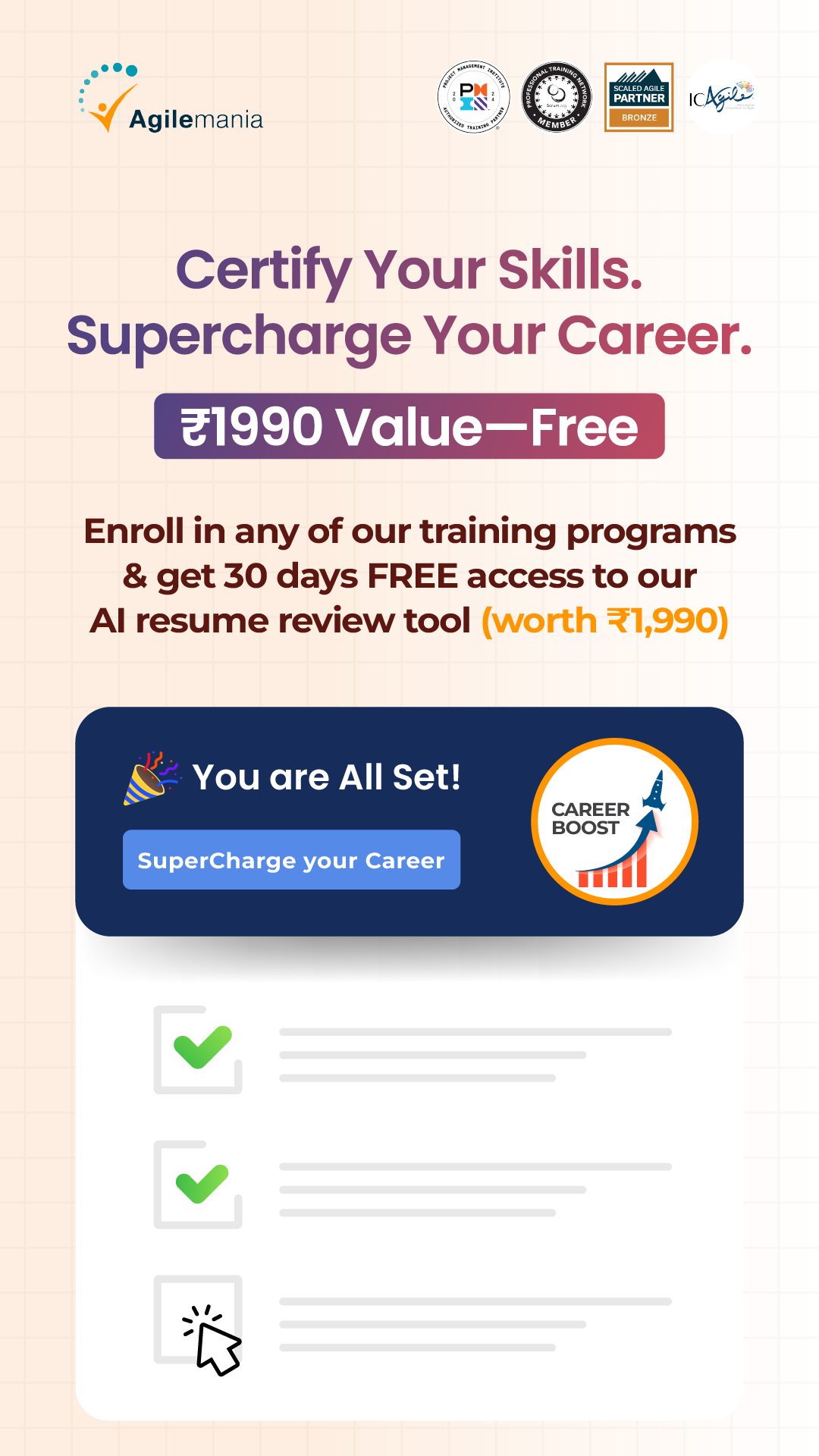



![65+ Software Testing Interview Questions and Answers [Updated]](https://cms.agilemania.com/storage/blog/6a5870bf295f71784180927.jpg "65+ Software Testing Interview Questions and Answers [Updated]")