


















Agilemania
Agilemania, a small group of passionate Lean-Agile-DevOps consultants and trainers, is the most tru... Read more


Agilemania
Agilemania, a small group of passionate Lean-Agile-DevOps consultants and trainers, is the most tru... Read more

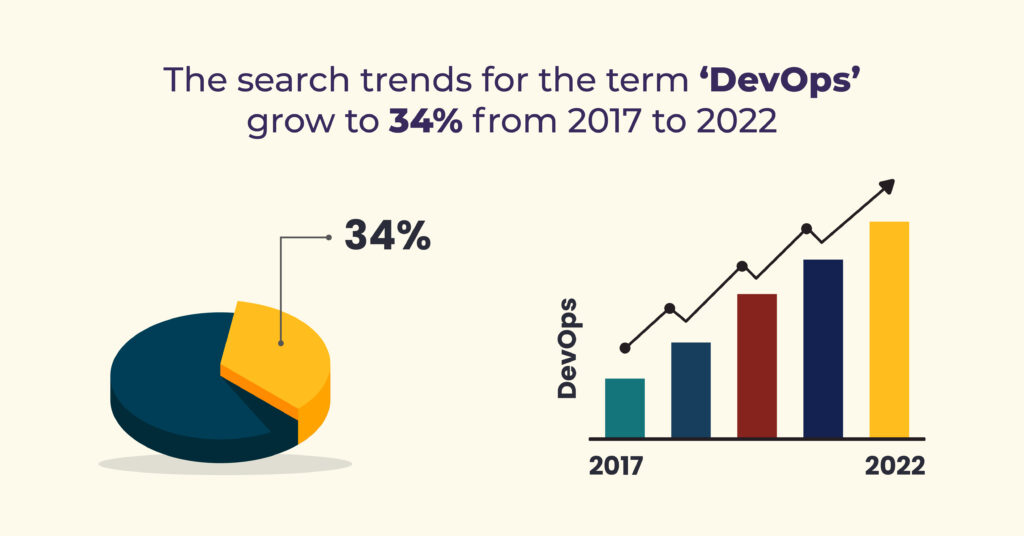
DevOps is a career in tech that has a lot of opportunities for skilled professionals. The search trends for the term ‘DevOps’ grow to 34% from 2017 to 2023.
The rise in demand for DevOps jobs is a corollary to the increasing DevOps adoption rate by companies. While 42% of the organizations are applying DevOps at the project or multiple project level, 23% of the organizations are implementing DevOps at the enterprise level.
If a career in DevOps excites you, then you have to gain certification for that after the completion of DevOps Certification Training. We have designed 30 DevOps Interview Questions that will help you become confident. This list has a mix of beginner, intermediate, and advanced questions to gauge your knowledge.
Here we go!
DevOps is a way of working where development (Dev) and operations (Ops) teams work together to build, test, release, and run software faster and more reliably.
Instead of working in silos, both teams share responsibility for the full software lifecycle, from writing code to deploying it and keeping it running smoothly.
In simple terms, DevOps helps teams deliver software faster, with fewer errors, by using collaboration, automation, and continuous improvement.
The technical and business benefits of DevOps are as follows-
Technical Benefits
Faster deployments: Automation helps teams release software quickly and frequently.
Fewer errors and failures: Continuous testing catches issues early, before they reach users.
Stable and reliable systems: Monitoring and quick rollback reduce downtime and outages.
Better collaboration: Developers and operations teams work as one team, not in silos.
Easy scalability: Cloud and automation make it easier to scale systems up or down.
Faster issue resolution: Logs, alerts, and monitoring help teams fix problems quickly.
Business Benefits
Faster time to market: Companies can launch features and products ahead of competitors.
Higher customer satisfaction: Fewer bugs and faster updates improve user experience.
Lower operational costs: Automation reduces manual work and rework.
Better product quality: Continuous feedback leads to steady improvement.
Improved team productivity: Teams spend less time fixing issues and more time building value.
Competitive advantage: Faster innovation helps businesses stay ahead in the market.
Better business agility: Organizations can respond quickly to market and customer needs.
DevOps |
Agile |
| DevOps is a combination of technical practices, tools, and cultural philosophies that help in the automation and assimilation of software development and IT services. | Agile is a time-bound agile project management methodology that follows an iterative approach that builds software in increments from the start till the completion of the project. It breaks down the larger project into phases and then builds the requirements in timeboxed iterations which typically last 2-4 weeks. |
| DevOps helps in managing end-to-end engineering concepts | Agile helps in managing large complicated projects |
| Concentrates on regular testing and delivery | Concentrates on frequent changes |
| The fundamental goal is collaboration so no rigid framework | Agile can be applied along with Scrum, SAFe, or a sprint |
In DevOps, the acronym CAMS represents the four core principles that guide DevOps practices.
C – Culture: Encourages collaboration, shared responsibility, and trust between development and operations teams.
A – Automation: Uses tools and scripts to automate testing, deployment, and infrastructure to reduce manual work and errors.
M – Measurement: Tracks metrics such as deployment frequency, failure rate, and system performance to improve continuously.
S – Sharing: Promotes sharing knowledge, tools, feedback, and learnings across teams.
Some of the Popular DevOps tools are-
Git is a version control tool used to track code changes. It allows multiple developers to work on the same codebase without conflicts. It is used for Source code management and collaboration.
Jenkins is a CI/CD automation tool. It automatically builds, tests, and deploys code whenever changes are made. It is Used for Continuous Integration and Continuous Delivery.
Docker is a containerization tool. It packages applications with all dependencies so they run the same in every environment. Used for: Creating lightweight, portable application containers.
Kubernetes is a container orchestration tool. It manages, scales, and monitors containers in production. Used for: Managing containerized applications at scale.
Ansible is a configuration management and automation tool. It automates server setup, application deployment, and configuration changes. Used for: Infrastructure automation and configuration management.
Terraform is an Infrastructure as Code (IaC) tool. It helps create and manage cloud infrastructure using code. Used for: Provisioning cloud resources in a repeatable way.
Nagios is a monitoring tool. It checks system health, server performance, and application availability. Used for: Monitoring and alerting.
Continuous Integration is defined as “The act of regularly integrating a small piece of code into a common body of code with regular verification that everything still works.”
In simple words, instead of developing for weeks and then committing all the development at once, programmers prefer to do so often, ideally every day. Once new code is checked in, automated tests such as the build and initial tests are done right away.
"You can think of it as a 'habit,' one that promotes steady progress as well as rapid feedback rather than last-minute fixes."
The key components of DevOps focus on improving collaboration, speed, and reliability across software development and operations. In simple terms, they include the following:
1. Continuous Planning: Teams plan work in small, manageable pieces. Requirements, priorities, and feedback are reviewed regularly so changes can be handled early instead of late.
2. Continuous Development: Developers write code in small increments and commit it frequently. This makes changes easier to track and reduces the risk of major issues during release.
3. Continuous Integration: New code is merged into a shared repository often. Each change is automatically built and tested to quickly detect errors.
4. Continuous Testing: Automated tests run regularly to ensure the software behaves as expected. This improves quality and reduces manual testing effort.
5. Continuous Deployment or Delivery: Once the software passes tests, it is released automatically (deployment) or kept ready for release (delivery). This shortens release cycles.
5. Continuous Monitoring and Feedback: The system is monitored in real time to track performance and issues. Feedback is shared with teams so they can improve future releases.
Git Bisect is a debugging feature in Git that helps you find the exact commit where a bug was introduced.
In simple terms, it works like a binary search. You tell Git one commit where the code worked correctly and another commit where the bug is present. Git then automatically checks a commit in between and asks you whether the bug exists there or not. Based on your answer, Git narrows down the range until it identifies the single commit that caused the issue.
This approach is much faster than checking commits one by one, especially in large projects. Git Bisect is commonly used when a problem appears suddenly and the team needs to quickly trace its origin.
The three main KPIs in DevOps are used to measure how fast and how reliably teams deliver software. They are:
1. Deployment Frequency: This measures how often new code is released to production. A higher frequency indicates that teams can deliver changes quickly and in small, manageable batches.
2. Lead Time for Changes: This tracks how long it takes for a code change to go from development to production. Shorter lead times show that the delivery process is efficient and free of major delays.
3. Mean Time to Recovery (MTTR): This measures how quickly a team can restore service after a failure or incident. Faster recovery reflects strong monitoring, automation, and operational practices.
Together, these KPIs give a clear picture of speed, efficiency, and stability in a DevOps environment.
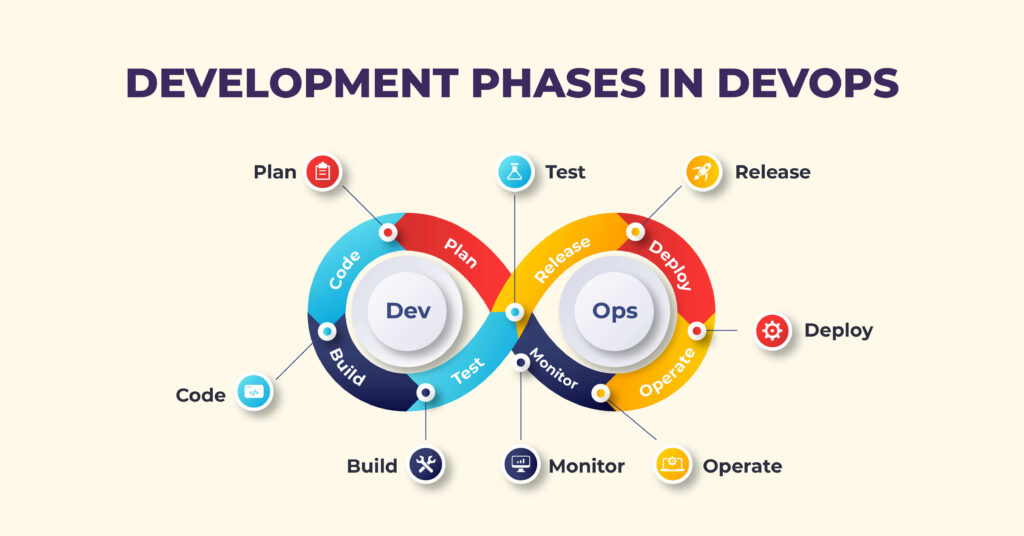
The phases of development in DevOps describe the complete lifecycle of building, releasing, and improving software. In simple terms, they include the following stages:
1. Planning: Teams identify requirements, define goals, and plan tasks based on business needs and user feedback.
2. Development (Coding): Developers write code and make small, frequent changes to the application.
3. Building: The code is compiled and packaged so it can be tested and deployed consistently.
4. Testing: Automated and manual tests are run to check functionality, performance, and quality.
5. Release: The tested build is approved and prepared for deployment.
6. Deployment: The application is deployed to production or staging environments, often using automation.
7. Operations: The system is maintained in a live environment, ensuring stability, availability, and performance.
8. Monitoring and Feedback: The application is continuously monitored, and feedback is collected to identify issues and improvements for the next cycle.
These phases work as a continuous loop, helping teams deliver software faster while maintaining quality.
Test your DevOps expertise with our comprehensive assessment! Get insights, improve skills, and advance your career.
Try it now!
Continuous Testing is the practice of running tests automatically and regularly throughout the software development process.
Instead of waiting until the end of development, tests are executed every time code is changed, integrated, or deployed. This helps teams detect defects early, verify that new changes do not break existing features, and maintain consistent quality.
In simple terms, Continuous Testing provides quick feedback on whether the software is ready to move to the next stage of delivery.
The advantages of using Git are mainly related to better control, collaboration, and safety while working on code. The five key advantages are explained below in detail.
Git keeps a complete record of every modification that was made to a project. Every time changes are made to one or more files in the project, Git saves who did it, when it was done, and what was changed. Thus, it is so easy to track progress, to look over and write, and to comprehend how the project evolved over time. In case there is a discovery of a mistake, teams will be able to go back to previous stable versions without losing work.
It makes it possible for different people to work on a project at the same time without conflicts occurring in their codebases. Although everyone can work on their copy of the project’s codebase independently, everyone can easily merge their codes without conflicts in a way that minimizes overlaps in a team.
Git version control also enables the working of developers on different features of the programs as different branches. If the programs on the different branches run properly, the programs can simply be merged back. If the programs on the different branches do not run properly, the programs can simply be discarded.
Designed to be Fast: Git is designed to run quickly. This is especially true for larger projects because much of it happens locally across the computer of developers rather than across a server or Internet connection. This means that it runs quickly and developers can finish their work efficiently even when Internet connectivity is low.
Anti-patterns in DevOps are common practices that look useful at first but actually reduce collaboration, slow delivery, or create instability. Below are some important DevOps anti-patterns:
1. Dev and Ops working in silos: When development and operations teams do not collaborate, issues arise during deployment, and accountability becomes unclear.
2. Treating DevOps as only a toolset: DevOps is not just about automation tools. Ignoring the culture and collaboration aspect defeats the purpose.
3. Manual deployments and lack of automation: Frequent manual work increases errors, slows down releases, and makes the process unreliable.
4. Skipping proper testing: Releasing code without continuous and automated testing leads to bugs in production and poor user experience.
5. Blaming culture instead of learning culture: When failures lead to blame rather than improvement, teams stop experimenting and progress slows down.
6. Ignoring monitoring and feedback: Without continuous monitoring, teams cannot detect issues early or improve system performance.
7. Overloading one team with all responsibilities: DevOps should be shared across teams. Making one group handle everything creates bottlenecks.
8. Big-bang releases instead of small changes: Large, infrequent releases increase risk and make troubleshooting difficult.
9. Lack of security integration (DevSecOps missing): Security should be part of the pipeline. Adding it only at the end creates vulnerabilities.
10. No clear ownership or accountability: If no one owns the full lifecycle of the service, problems remain unresolved and quality drops.
Avoiding these anti-patterns helps organizations gain the true benefits of DevOps: faster delivery, better quality, and stronger collaboration.
A Canary Release is a software deployment strategy where a new version of an application is released to a small group of users first, before rolling it out to everyone.
In simple terms, instead of deploying changes to all users at once, the team introduces the update gradually. They monitor performance, errors, and user feedback during this limited release. If everything works well, the new version is then deployed to the rest of the users. If problems appear, the release can be stopped or rolled back quickly with minimal impact.
Canary releases help reduce risk and ensure safer, more controlled deployments.
Clear collaboration between development, operations, and testing teams to ensure everyone works toward shared delivery goals.
A strong version control system like Git to manage code changes and support team-based development.
Automation readiness for builds, testing, and deployments to reduce manual effort and improve consistency.
Continuous Integration and Continuous Delivery (CI/CD) pipeline setup to enable faster and reliable software releases.
Proper infrastructure management using tools or cloud platforms to support scalable and repeatable environments.
Monitoring and logging systems in place to track application performance and detect issues early.
A culture of continuous improvement where teams regularly learn from failures and optimize processes.
Security practices are integrated into the workflow (DevSecOps) to ensure safe and compliant deployments.
Skilled team members with basic knowledge of development, operations, and automation concepts.
Management support and commitment to adopt DevOps practices across the organization.
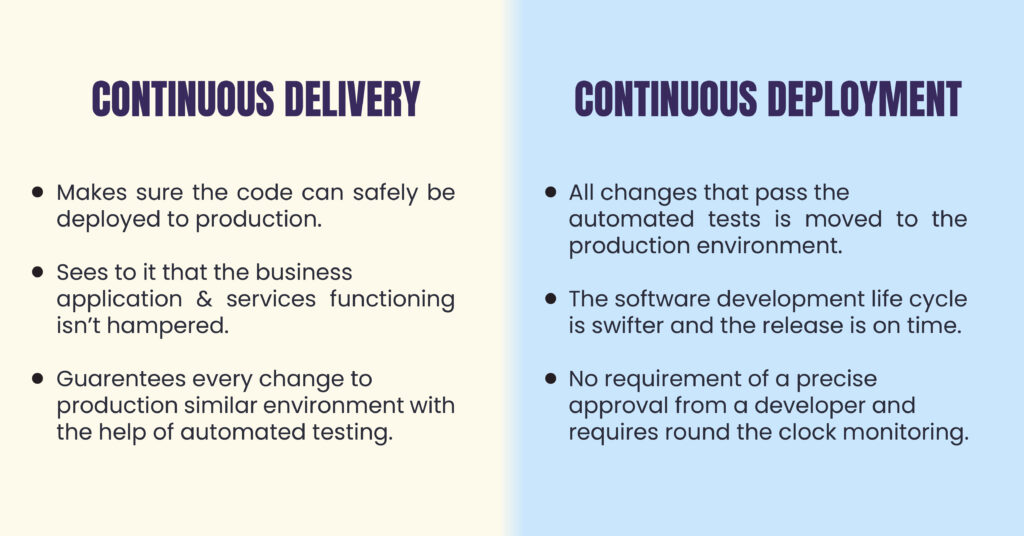
CBD (Component-Based Development) is a software development approach where applications are built by combining reusable, independent components instead of writing everything from scratch.
In simple terms, a component is a self-contained module that performs a specific function, such as a login system, payment module, or user interface element. Developers can reuse these components across different projects, which saves time and improves consistency.
Component-Based Development helps in faster development, easier maintenance, and better scalability because components can be updated or replaced without affecting the entire system.
Resilience Testing is a type of testing that checks how well a system can handle failures, disruptions, or unexpected conditions and still continue working.
In simple terms, it measures the ability of an application to recover quickly from issues such as server crashes, network failures, heavy traffic, or hardware problems. The goal is to ensure the system remains stable, reliable, and available even under stress.
Resilience Testing is important for building software that can perform well in real-world conditions where failures can happen anytime.
Version Control is a system that helps track, manage, and organize changes made to files or code over time.
In simple terms, it allows developers to save different versions of a project, so they can see what was changed, who changed it, and when it was changed. If something goes wrong, they can easily return to an earlier working version.
Version control also supports teamwork by allowing multiple people to work on the same project without overwriting each other’s work.
The principles of DevOps focus on improving collaboration, speed, and reliability in software delivery. The key principles include:
These principles help organizations deliver high-quality software efficiently and reliably.
Master essential skills, tools & strategies. Expert tips for acing interviews in 2025. Elevate your DevOps journey now!
Elevate your DevOps journey now!
Pair Programming is a software development practice where two developers work together on the same task at one workstation.
In this approach, one person writes the code (called the driver) while the other reviews each line, suggests improvements, and thinks about the overall design (called the navigator). They switch roles regularly.
Pair Programming helps improve code quality, reduce mistakes, share knowledge within the team, and solve problems faster through collaboration.
The different types of HTTP requests (also called HTTP methods) are:
GET – Used to request and retrieve data from a server.
POST – Used to send data to the server, often to create a new resource.
PUT – Used to update or replace an existing resource on the server.
PATCH – Used to make partial updates to a resource.
DELETE – Used to remove a resource from the server.
HEAD – Similar to GET, but retrieves only headers, not the full content.
OPTIONS – Used to check which HTTP methods are supported by the server.
TRACE – Used to track the path of a request for debugging purposes.
CONNECT – Used to establish a secure tunnel, mainly for HTTPS connections.
A Build is the process of converting source code into a runnable or deployable application.
In simple terms, it includes steps like compiling code, linking files, packaging resources, and generating executable files or software packages. The build process ensures that the application is properly prepared to be tested, deployed, or released.
Builds are often automated in DevOps using tools like Maven, Gradle, or Jenkins to maintain consistency and reduce manual errors.
Configuration Management in DevOps is used to manage and maintain consistent system settings, software configurations, and infrastructure across different environments.
In simple terms, it ensures that servers, applications, and tools are set up the same way in development, testing, and production. This reduces errors caused by environment differences and makes deployments more reliable.
The key uses of configuration management in DevOps include:
Automating the setup and maintenance of servers and applications
Ensuring consistency across all environments
Reducing manual configuration errors
Supporting faster and repeatable deployments
Helping teams track and control configuration changes over time
Tools like Ansible, Puppet, Chef, and SaltStack are commonly used for configuration management in DevOps.
Selenium is used in DevOps mainly for automated testing of web applications.
In a DevOps environment, teams release software frequently, so testing must be fast, repeatable, and reliable. Selenium helps achieve this by automating browser-based testing.
The key reasons Selenium is used in DevOps are:
It automates functional testing of web applications, reducing manual effort.
It supports continuous testing in CI/CD pipelines, ensuring code changes are validated quickly.
It helps detect bugs early by running tests after every build or deployment.
It improves software quality by testing user workflows across different browsers.
It speeds up the release process by enabling faster feedback to developers.
Overall, Selenium supports DevOps goals by making testing more efficient and continuous.
Containers are lightweight, portable units that package an application along with all its dependencies, libraries, and configuration files needed to run. In simple terms, a container ensures that software works the same way in every environment, whether it is a developer’s laptop, a testing server, or a production system.
Containers are widely used in DevOps because they:
Provide consistent and reliable application deployment
Start quickly and use fewer resources than virtual machines
Make scaling and management easier in cloud environments
Popular container tools include Docker and Kubernetes.
Two-factor authentication (2FA) is a security method that requires a user to verify their identity using two different steps before accessing an account or system.
In simple terms, instead of logging in with only a password, the user must provide:
Something they know (like a password or PIN)
Something they have or are (like a one-time code sent to a phone, a fingerprint, or an authentication app)
Two-factor authentication adds an extra layer of protection and reduces the risk of unauthorized access, even if the password is stolen.
Vagrant is a tool used to create and manage virtual development environments in a simple and automated way.
In simple terms, it helps developers set up the same working environment on different machines, so the software behaves consistently for everyone on the team.
Vagrant is commonly used in DevOps because it:
Creates repeatable and portable environments
Reduces “it works on my machine” problems
Automates virtual machine setup using configuration files
Works with providers like VirtualBox, VMware, and cloud platforms
Overall, Vagrant makes development and testing environments easier to build, share, and manage.
Post-mortem meetings are discussions held after a major incident, failure, or outage in a system to understand what happened and how to prevent it in the future.
In simple terms, the team reviews the event in detail, including:
What caused the problem
How it was detected
How the team responded and resolved it
What impact did it have on users or the business
What improvements can be made to avoid similar issues again
Post-Mortem meetings focus on learning and process improvement, not blaming individuals. They are an important part of building reliability in DevOps.
Forking Workflow is a Git collaboration model where developers create their own copy of a repository (called a fork) and make changes independently before contributing back to the main project.
In simple terms, instead of working directly on the original repository, each developer:
Forks the repository to their own account
Makes changes in their fork
Pushes updates to their copy
Submits a Pull Request to merge changes into the main repository
Forking Workflow is commonly used in open-source projects because it provides better control, improves security, and prevents unauthorized changes to the main codebase.
Yes, DevOps engineers average salary is generally high because they directly impact business performance and efficiency, organizations are willing to offer competitive salaries across industries and regions.
To prepare for a DevOps interview, start by building a strong understanding of both development and operations basics. Learn key concepts like CI/CD, automation, version control with Git, containerization with Docker, and cloud platforms such as AWS or Azure. Practice common DevOps tools like Jenkins, Kubernetes, Ansible, and Terraform. Also focus on Linux commands, scripting, and monitoring practices. Finally, review real-world scenarios, be ready to explain workflows clearly, and prepare to discuss how DevOps improves collaboration, speed, and reliability in software delivery.
SQL is not always mandatory for DevOps, but having basic knowledge can be helpful. DevOps engineers mainly focus on automation, deployment, infrastructure, and monitoring, rather than database development. However, understanding SQL becomes useful when working with applications that rely on databases, troubleshooting production issues, managing data-related deployments, or supporting database automation. So, while SQL is not a core requirement, learning the basics can add value in many DevOps roles.
DevOps is not completely full of coding, but it does involve some level of scripting and automation. DevOps engineers usually write code to automate tasks like deployments, infrastructure setup, monitoring, and CI/CD pipelines. The coding is more focused on improving processes and reducing manual work rather than building full software applications. So, while deep programming is not always required, basic coding and scripting skills are important in DevOps.
DevOps is not being replaced by AI, but AI is becoming a helpful support in DevOps practices. AI can automate repetitive tasks, improve monitoring, detect issues faster, and assist with smarter decision-making. However, DevOps still requires human expertise for planning, collaboration, security, system design, and managing complex workflows. Instead of replacing DevOps roles, AI is enhancing them by making processes faster and more efficient.
Agilemania, a small group of passionate Lean-Agile-DevOps consultants and trainers, is the most trusted brand for digital transformations in South and South-East Asia.
WhatsApp Us